Activity
You can see the activities of the ISFT institute
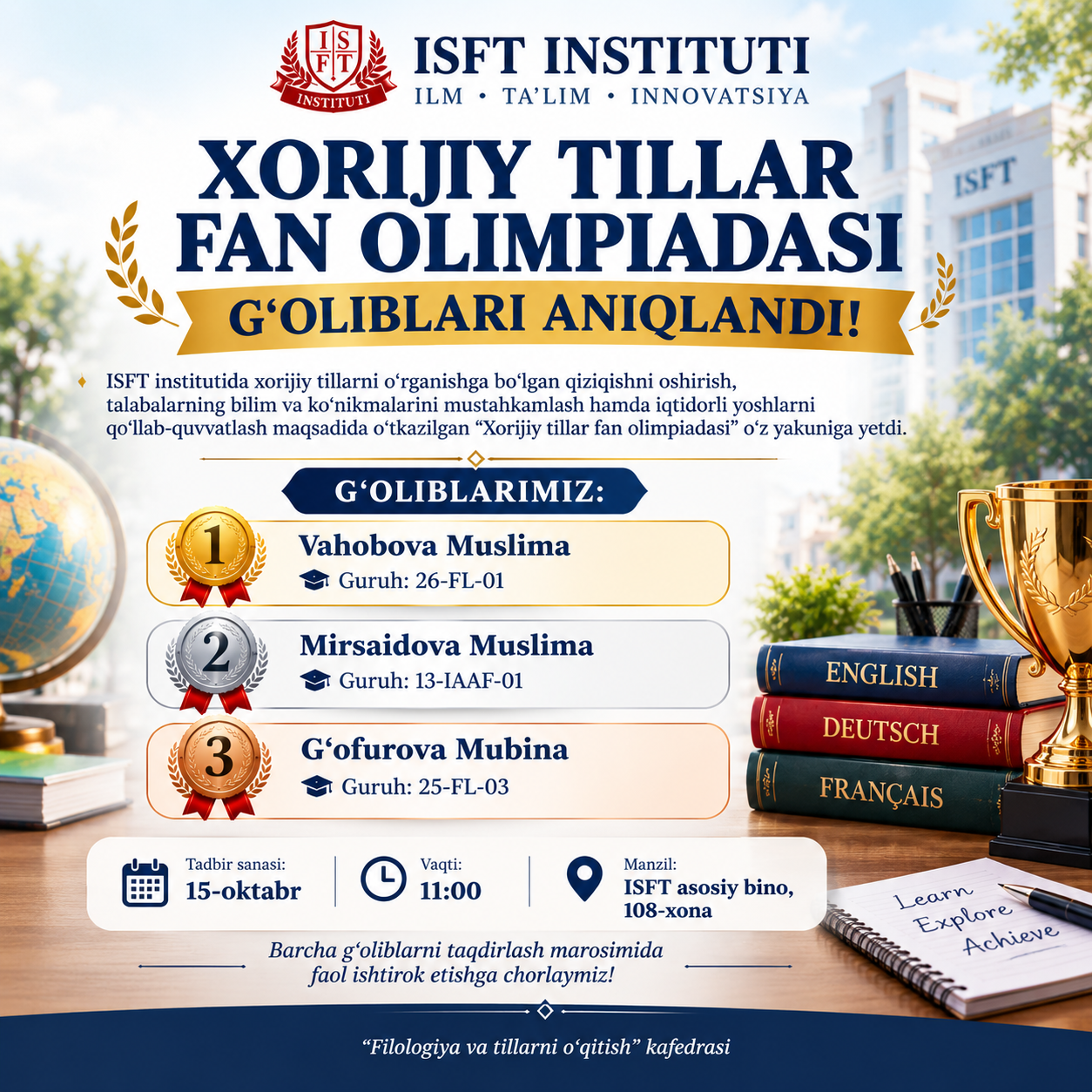
The Winners of the Foreign Languages Olympiad Have Been Announced
The Foreign Languages Olympiad held at ISFT Institute has come to an end. The event was organized to increase students’ interest in learning foreign languages, strengthen their knowledge and practical language skills, and identify and support talented and motivated students.
Throughout the Olympiad, participants demonstrated their knowledge, abilities and level of preparation, showing strong motivation, commitment to learning and a high level of academic engagement. Following the results of the competition, 1st place was awarded to Muslima Vahobova (26-FL-01), 2nd place to Muslima Mirsaidova (13-IAAF-01), and 3rd place to Mubina G‘ofurova (25-FL-03).
The awards ceremony for the winners will be held on October 15 at 11:00 AM in Room 108 of the main building of ISFT Institute. The winners will be recognized and awarded for their outstanding results and achievements in the Olympiad.
ISFT Institute sincerely congratulates all the winners on their well-deserved success and wishes them continued achievements in their academic, scientific and professional careers. Such intellectual competitions play an important role in developing students’ knowledge, abilities and intellectual potential, while encouraging them to pursue excellence and continuous self-development.
08
Scientific journal
The scientific-methodological journal, published quarterly in electronic form, features scientific articles and theses on achievements and challenges in business, management, and pedagogy, along with recommendations for conducting research and commentary on regulations, laws, decrees, orders, and instructions.
Scientific Research
ISFT Scientific Research Center
Tadqiqotlar
View AllRustamova Lola
Rustamova Foundation doctoral student of Lola isft Institute
Deberdiev Anvar
Deberdiev Anwar isft Institute Foundation doctoral student
Yusupov Ulug‘bek
Yusupov Ulugbek Isft Institute Foundation doctoral student
Conferences
View All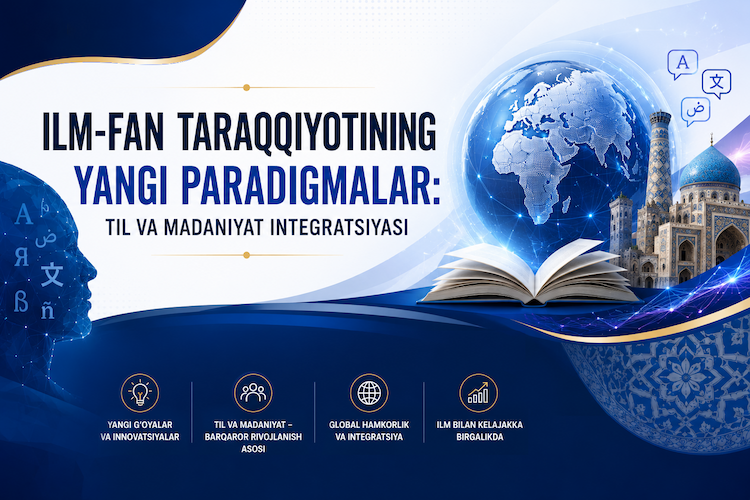
“New Paradigms of Scientific Development: Integration of Language and Culture” International Scientific and Practical Conference, May 22, 2026.
13
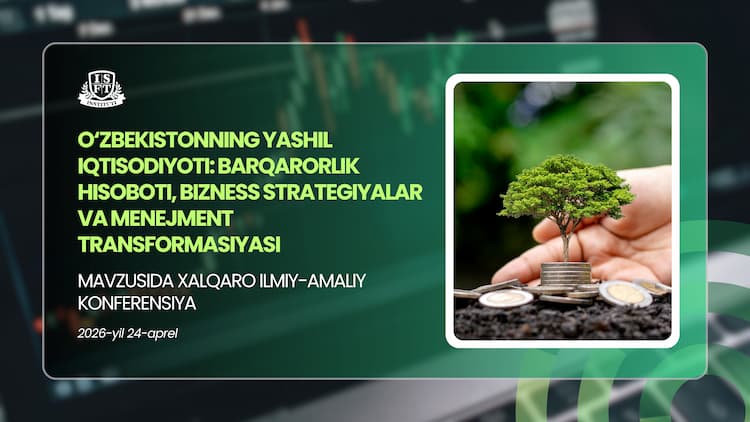
International scientific-practical conference on the topic: "Green Economy of Uzbekistan: Sustainability Reporting, Business Strategies, and Management Transformation", April 24, 2026.
24
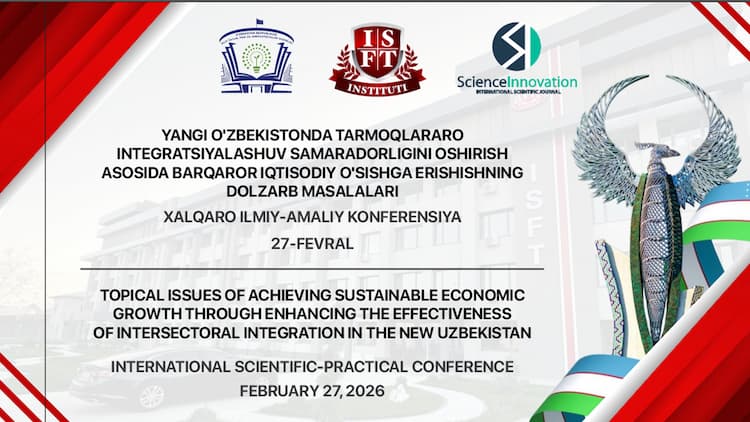
“International Scientific and Practical Conference on ‘Topical Issues of Achieving Sustainable Economic Growth through Enhancing the Effectiveness of Intersectoral Integration in New Uzbekistan’”
17
Maqolalar
Extended Departmental Scientific Discussion of the Dissertation
Sharipov Hayotjon Safarovich Discussion of the dissertation for the degree of Doctor of Philosophy (PhD) in Psychology entitled “Socio-Psychological Characteristics of the Manifestation of Initiative and Leadership Qualities among Trade Union Employees” prepared in the specialty 19.00.05 – Social Psychology. Ethnopsychology.
Academic supervisor: Doctor of Philosophy (PhD) in Psychology, Associate Professor, O. Qodirova
Reviewers:
Daukeeva Aydin Oralbayevna – Doctor of Psychological Sciences (DSc), Associate Professor
Axmedova Dildora Olimjonovna – Doctor of Philosophy (PhD) in Sociology, Associate Professor
Date and time:
14 October 2026, at 14:00
Zoom link:
https://us05web.zoom.us/j/85282339061?pwd=Qs73dhzO...
Meeting ID: 852 8233 9061
Passcode: 8HmsJS
Extended Departmental Scientific Discussion of the Dissertation
Jo‘rayeva Shaxnoza Saatmuradovna Discussion of the dissertation for the degree of Doctor of Philosophy (PhD) in Psychology entitled “Psychological Factors in the Manifestation of Personality and Emotional Characteristics among Unemployed Women” prepared in the specialty 19.00.05 – Social Psychology. Ethnopsychology.
Academic supervisor: Doctor of Philosophy (PhD) in Psychology, Associate Professor, O. Qodirova
Reviewers:
Jo‘rayev Baxrom – Doctor of Psychological Sciences (DSc), Professor
Turgunova Gulru Tojibayevna – Doctor of Philosophy (PhD) in Psychology, Associate Professor
Date and time:
14 October 2026, at 14:00
Zoom link:
https://us05web.zoom.us/j/85282339061?pwd=Qs73dhzO...
Meeting ID: 852 8233 9061
Passcode: 8HmsJS
Extended Departmental Scientific Discussion of the Dissertation
Kasimov Sanjar Tulyaganovich Discussion of the dissertation for the degree of Doctor of Philosophy (PhD) in Psychology entitled “Socio-Psychological Factors in Preventing Offences in the Migration Process” prepared in the specialty 19.00.05 – Social Psychology. Ethnopsychology.
Academic supervisor: Ravshanov Lochinbek Urinovich Doctor of Psychological Sciences (DSc), Professor
Reviewers:
Umarova Navbahor Shokirovna – Doctor of Psychological Sciences (DSc), Professor.
Sharapova Dildora Baxtiyarovna – Doctor of Philosophy (PhD) in Psychology
Date and time:
14 October 2026, at 14:00
Zoom link:
https://us05web.zoom.us/j/85282339061?pwd=Qs73dhzO...
Meeting ID: 852 8233 9061
Passcode: 8HmsJS
Educational activity
You can view our institute's curriculum and study schedule
Curricula
Study Schedule
Educational process schedules
Educational process schedule for the 2025-2026 academic year
International collaboration
International Relations Division
The International Co-operation Department is a structural subdivision of ISFT. The department carries out its activities on the basis of the legislation of the Republic of Uzbekistan.
The International Cooperation Department of the Institute functions to establish links and cooperation with foreign higher education institutions, research centres and training institutes to study the latest educational and scientific experience and apply it in education. The department also coordinates and manages such organisational work as exchange of students and professors, trainings and professional development in prestigious educational institutions of the world.
OBJECTIVES OF THE DIVISION
- Participation of ISFT in international rankings;
- Expansion of international research projects, programmes, grants and cooperation with foreign universities, research institutions and organisations. Attract professors and lecturers of international standards;
- Ensure international recognition of ISFT.
Social activity
ISFT’s Dedication to achieving the UN SDGs
View AllThe Sustainable Development Goals (SDGs) are the global plan aimed at achieving a balance between economic development, social inclusion, and environmental conservation to build a better future for the whole world.
Sustainable development implies that the current generation can satisfy its needs without jeopardising the future generation's needs. It involves combined effort on three levels: creating prosperity, creating equity and protecting the planet.
The 2030 Agenda, developed by the United Nations, including 17 Goals, demands urgent cooperation with a focus on poverty, inequality, climate change, and environmental degradation, as well as on the promotion of peace and justice.
ISFT Institute is dedicated to embedding these objectives across our policies, curriculum, and campus initiatives. Guided by values of inclusive education, responsible resource management, and collaborative impact, we ensure that sustainability is not just a vision but a measurable reality. Our commitment is demonstrated through tangible actions—expanding renewable energy use, improving accessibility, and fostering active community engagement—so that no one is left behind as we build a resilient and equitable future.